In February I named my word game Glyphfall. Since then I keep running into other Glyphfalls: an arena shooter, a terminal ARPG, a roguelike deckbuilder, an Android dungeon crawler. GitHub had no repository by that name before 2026, and it has fifteen now. I talked to two of their developers, and both told me an AI came up with the name.
One name is an anecdote. The question behind it is bigger: when you ask a model to name something, how many other people got the same answer?
So I measured it, across ten kinds of project.
How I measured it
The setup follows the coding-agent experiment from a month ago: the same brief to many models, each run in a fresh empty directory, each client from a clean home that holds nothing but its login. No rules, no memory, no MCP servers.
Ten briefs, each two sentences. Four are games: falling letters you swipe into words, a typing game where words fall, a roguelike drawn in ASCII in the terminal, and "an indie game" with no detail at all as a control. Six are other things people ask a model to name: an invoicing SaaS for freelancers, a CLI tool that watches log files, an AI support startup, a TypeScript validation library, the heroine of a fantasy novel, and a podcast about software engineering. They all end the same way, apart from small wording changes:
Suggest 10 names for it. Answer with just the names, one per line, best first.
Do not look anything up.Nine models answered all ten briefs five times: Opus, Sonnet and Haiku 5.5 in Claude Code, GPT-5.6 Sol, Terra and Luna, GPT-6 Astra and GPT-6.1 Sol in Codex, and Gemini 3.8 Flash in Antigravity. That core is 450 runs, and every figure below comes from it unless I say otherwise. Ten free models in OpenCode and Freebuff answered the four game briefs, with one or two runs each. In total that makes 505 runs from 19 models, all on 1 November 2026.
450 names, far fewer different ones
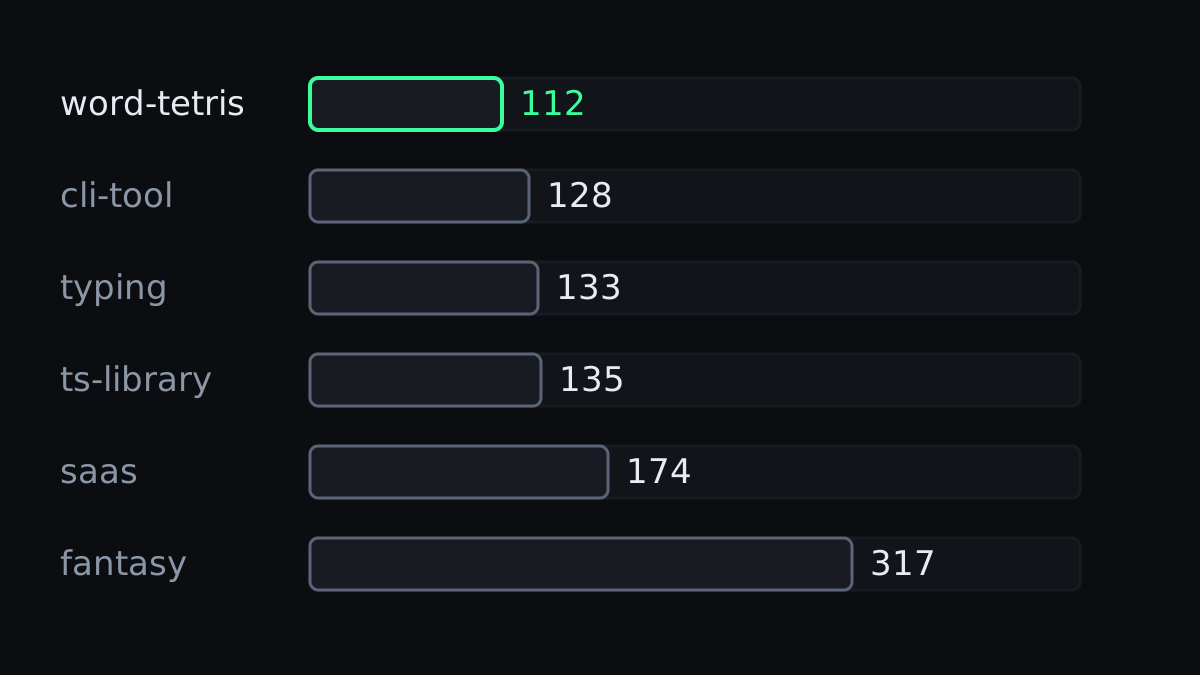
Ten names per run, five runs, nine models: 450 names per brief. For the CLI tool, 128 of them are different. For the word game, 112.
| Brief | Distinct names, of 450 | What all nine models suggested |
|---|---|---|
| Falling letters | 112 | Wordfall, Letterfall, StackSpell |
| CLI log watcher | 128 | Spikewatch |
| Typing game | 133 | Wordfall, Typefall |
| Validation library | 135 | formcheck |
| Invoicing SaaS | 174 | Ledgerly |
| Podcast | 201 | none, Merge Conflict came first in 9 runs |
| AI support startup | 267 | none |
| Indie game | 285 | none, Lanternfall came first in 10 runs |
| Terminal roguelike | 300 | none |
| Fantasy heroine | 317 | none |
Three vendors, nine models, and for half the briefs there is a name every one of them comes up with. Spikewatch appeared in 31 of the 45 runs for the log watcher. Wordfall was the first suggestion for the word game in 33 of 59 runs across all 19 models.
The more concrete the brief, the narrower the answers. A word game, a log watcher and a validation library each describe one mechanism, and the names collapse onto it. A fantasy heroine or "an indie game" leaves more room, so the lists spread out.
The spread still hides favourites, though. The fantasy heroine has 317 distinct full names, yet Isolde appears in 35 of the 45 runs and Elara in 17, from seven of the nine models. The indie game has no detail at all, and Hollowlight was still the first pick in 13 runs across all 19 models.
The name comes out of your brief
Where do the shared names come from? Mostly from the nouns in the brief. Invoices give Ledgerly, logs and spikes give Spikewatch, form validation gives formcheck. The model takes the most telling word from your description and attaches a suffix that sounds like a product.
The roguelike shows how strong that pull is. In 57 of its 59 runs the list contained a name with glyph in it: Glyphgrave, Glyphbound, Glyphdeep, Glyphcrawl. "ASCII" pulls the model towards glyph, and from there the step to Glyphfall is short.
Glyphfall itself came up in 13 roguelike runs from 9 models, and in 11 of them it was the first pick. Eight of those thirteen runs come from the free models, which got fewer runs, but Gemini, Sonnet and GPT-5.6 Sol came up with it too.
That explains the Glyphfalls where nothing falls. Nobody needed to copy anyone. A terminal ARPG and a dungeon crawler get the same name because their briefs share the same telling word.
New is not the same as original
Glyphfall did not exist before 2026, so in one sense the models invented it. Nothing in it is new, though.
Glyph is another word for a letter or a character, which is how my game uses it. In the roguelike brief the model reaches for it as soon as it reads "ASCII". Fall comes from a genre full of falling things, and the join is the kind of compound the training data is full of: Wordfall, Letterfall, Starfall.
A model picks the likeliest next piece. It does not check whether anyone has taken the name since its training cutoff, or whether the .com already exists. And the likeliest combination of two likely pieces is the same for everyone who asks.
That is the parrot from April at work on a name. It can produce a word nobody has written before, and that word will still be the most probable one. Ask for ten names and you get the ten most probable, in roughly the order everyone else gets them.
Sampling adds some chance, which is why Opus does not say the same name first every time. That chance stays close to the top of the list. An original name would mean picking the unlikely option on purpose, and a model drawing from a probability distribution is built to avoid exactly that.
The favourites are often taken
The names the models agree on are usually the ones that already exist. formcheck, the package name all nine suggested for the validation library, has been on npm since 2018. Merge Conflict has been a development podcast since 2016, and Ship It, suggested by five models, was a Changelog show.
The model offers them as fresh ideas. In my runs it was told not to look anything up, and in a chat you usually do not ask it to.
You can watch them spread
For a few of the names from the experiment I counted GitHub repositories per year of creation:
| Name | Before 2023 | 2023 to 2024 | 2025 | 2026 so far |
|---|---|---|---|---|
| Glyphfall | 0 | 0 | 0 | 15 |
| Hollowlight | 0 | 1 | 1 | 13 |
| Emberwake | 0 | 0 | 4 | 42 |
| Ledgerly | 2 | 10 | 148 | 803 |
I cannot prove that every one of those 803 Ledgerly repositories got its name from a model. But all nine models suggest it for an invoicing app, and it went from 10 repositories in 2023 and 2024 together to 803 this year.
The obvious names behave differently. Wordfall has 101 repositories, 67 of them from before 2026, and Letterfall 38, of which 25 are older. People have been giving those names to falling-letter games for years. The coined ones, like Glyphfall, Emberwake and Hollowlight, barely existed until the models started handing them out.
Each model also has a favourite
Within one model the answers are narrower still. Over five runs, Opus 5.5 gave on average two different first picks per brief, and for four of the ten briefs it named the same thing first every single time. Haiku varied most, at 3.7 out of 5. None of the nine came close to five different first picks.
Across all 19 models, two runs from different models picked the same first name in a quarter of the cases for the typing game and a third for the word game. Two runs from the same model did so in half to two thirds of the cases. The models share a pool of candidates, and each model has its own favourite within it, much like the handwriting each model line showed in code.
What this does not show
- That the people behind those repositories used AI. Two Glyphfall developers told me so. One itch.io page states that no generative AI was used. For the rest I do not know.
- How a chat behaves. I used the coding clients without a conversation or memory around the prompt. A chat that knows more about you may spread wider, or may land on the same names.
- Whether the names are any good. I counted how often models give the same name, not whether that name works. Wordfall is a fine name for a game in which words fall. The only problem is that everyone gets it.
- Equal weight per model. The nine core models have five runs per brief. The free models in OpenCode and Freebuff have fewer, and only for the game briefs.
What to do with an AI name
Treat the first suggestion as everyone's first suggestion. If your brief resembles someone else's, there is a fair chance they got the same list this month. The top of the list is where the collisions sit.
Search before you get attached. GitHub, npm or your package registry, itch.io and the app stores, and the domain. Five minutes. The model will not do it for you, and the names it agrees on most are the ones most likely to be taken.
Check whether a model comes up with your name by itself. A word that feels unusual to you can be the obvious choice for a model. I chose glyph as another word for letters, and still 7 models came up with Glyphfall as soon as I described my game in two sentences. So give your brief to a few models before you settle on a name: if your name is on their list, it is on the next person's list too.
I would rather not think too hard about what it says about me that I made the same choice as seven language models. Maybe I should start calling myself TimGPT.
A name from a model is the default for your brief. Sometimes the default fits: my game really is about falling letters. For a roguelike where nothing falls, Glyphfall is what a model says when you mention ASCII, and the next person to mention ASCII gets it too.